
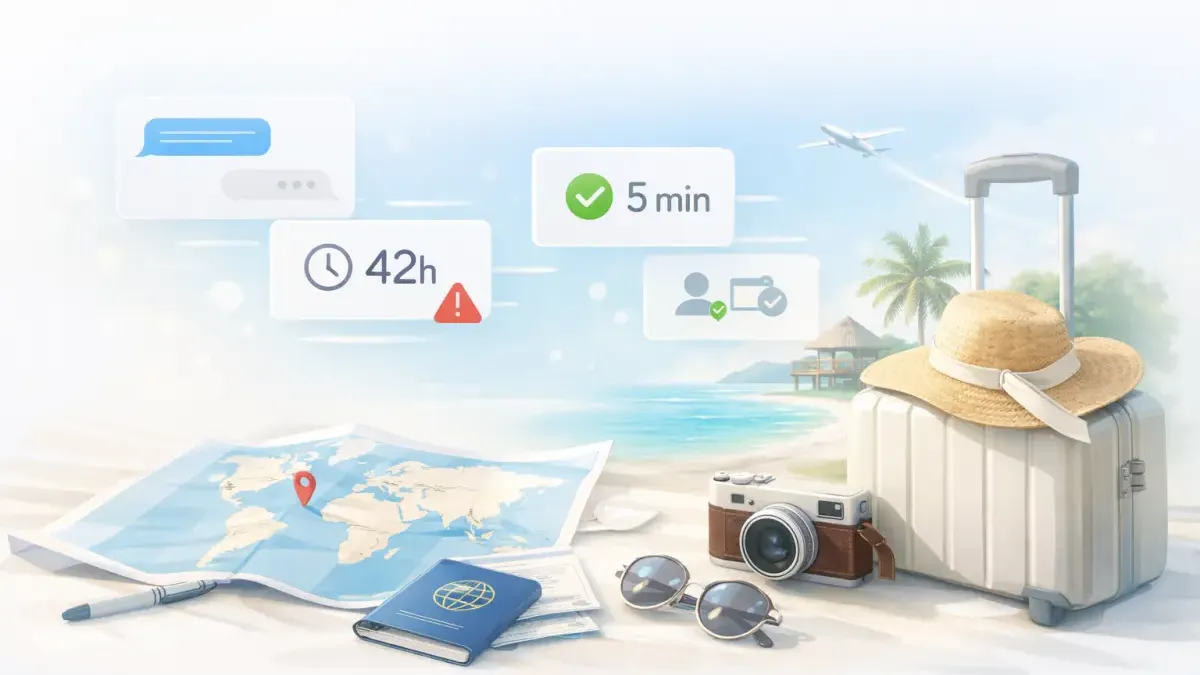
The average travel booking inquiry response time is 42 hours. A traveler planning on Sunday afternoon has submitted to three competitors by Monday morning. For tour operators, response speed isn't a service metric - it's the primary revenue variable.
TL;DR
- Average travel inquiry response time is 42 hours - most bookings are decided in the first few hours
- AI conversations respond instantly, collect trip parameters, and surface the right itinerary options before a human is involved
Table of Contents
When Travelers Plan and When They Buy
Trip planning happens in compressed sessions. A traveler opens six browser tabs on a Sunday afternoon - researching destinations, comparing tour operators, scanning reviews. They submit inquiries to 3-5 operators in a single sitting. Then they wait.
The booking window is short. The days of browsing for months are shrinking. When a traveler submits an inquiry, they are ready to move - not casually browsing.
A traveler planning a $5,000 family vacation wants reassurance and guidance, not silence.
The competitive landscape makes this worse. OTAs like Booking.com and Expedia respond instantly with automated confirmations and dynamic pricing. Tour operators - who offer higher-value, personalized experiences - respond in days. The operator who takes 42 hours to acknowledge an inquiry is not competing against the operator who takes 24 hours. They are competing against the OTA that responded in 4 seconds.
These are not just operational metrics. They are revenue leaks.
Bereit, Formulare durch Konversationen zu ersetzen?
Gnosari verwandelt statische Formulare in KI-gestützte Konversationen, die bessere Daten mit höheren Abschlussraten erfassen.
Kostenlos startenTry the trip-planning Gnosari
LivePretend you're planning a trip. See how the Gnosari takes your inquiry as a conversation instead of a form.
The Cost of a 42-Hour Response
A slow response does not just delay a booking. It eliminates the booking entirely.
The competitor already responded. While your team opens the inbox on Tuesday morning, the traveler has received detailed proposals from two other operators and an OTA booking confirmation. Your response arrives as noise in an inbox of someone who already committed $4,000 elsewhere.
Trip planning stress compounds. 70-71% of US and UK travelers find the trip planning process stressful. Travelers who don't get fast responses from tour operators don't just book elsewhere - they default to the lower-effort option. That usually means an OTA, where they can complete a booking in 8 minutes without waiting for a human to email back.
OTA abandonment is already massive. OTA booking abandonment rates reach 89-94%. Travelers abandon even the fastest platforms. Tour operators who are slower than the fastest platforms start from an even deeper deficit.
Lifetime value disappears. A traveler who would have booked a $3,000 guided tour annually for the next five years - $15,000 in lifetime value - becomes a self-service OTA user after a single unanswered inquiry. The 42-hour response time did not lose one booking. It lost a client.
How AI Conversations Close the Response Gap
The response time problem is structural. Tour operators are small teams. Most inquiries arrive outside business hours - during Sunday planning sessions, evening research windows, and across time zones. Hiring for 24/7 coverage is not viable for a 5-person tour operator.
AI conversations solve this by responding the moment an inquiry arrives - at 2 PM or 2 AM - and collecting the structured data your travel specialists need to prepare a relevant proposal.
Instant acknowledgment with structured intake. The AI doesn't just say "thanks, we'll get back to you." It starts collecting: destination or region, travel dates (and flexibility), party size and composition, trip type (adventure, luxury, cultural, family, honeymoon), and budget range.
Budget and preferences captured in the first conversation. No phone tag. No three-email chain to establish basics. The AI collects the 8-10 qualifying data points - including activity interests, dietary needs, and special requirements - that determine which itineraries to present.
Qualified briefs delivered to specialists. Your travel specialist starts Monday morning with a complete brief: "Party of 4, adults + 2 children ages 8 and 12, 10-day cultural tour of Japan, mid-range budget ($3,000-4,000 per person land-only), interested in cooking classes and temple visits, one guest requires vegetarian meals, flexible on dates within October." That specialist can have a tailored itinerary proposal ready in hours, not days.
This is where Gnosari fits for travel operators: AI conversations that respond instantly to trip inquiries, collect destination and travel parameters through natural dialogue, and deliver a qualified brief to your specialists. No forms. No voicemail. No 42-hour gap.
Why Speed Decides the Booking
Travelers inquire with several operators at once and book with whoever responds first with something concrete. In travel, response speed is even more consequential because of average booking values.
The itinerary as closing tool. Travelers who receive a preliminary itinerary within hours of their inquiry are significantly more likely to book. A structured intake conversation makes this possible - when the specialist has destination, dates, party size, budget, and interests before the first call, they can present 2-3 relevant itineraries instead of spending 30 minutes qualifying.
The revenue math. Consider a mid-size tour operator handling 200 monthly inquiries:
| Metric | 42-Hour Response | Instant AI Response |
|---|---|---|
| Monthly inquiries | 200 | 200 |
| Intake completion rate | 40% (80 qualified) | 72% (144 qualified) |
| Lead-to-booking conversion | 15% (12 bookings) | 18.75% (27 bookings) |
| Average booking value | $2,500 | $2,750 (+10% via personalization) |
| Monthly revenue | $30,000 | $74,250 |
That is $44,250 in additional monthly revenue - $531,000 per year - from solving the response time problem.
The personalization premium is real. The connection between structured intake data and personalized proposals is the revenue engine.
The AI conversation is the structured data layer that makes the CRM actually work.
Häufig gestellte Fragen
Related Reading
- AI Trip Planning Intake for Tour Operators - Collect Trip Parameters Instantly - How AI conversations replace intake forms for tour operators
- Automate Travel Lead Qualification - Stop Losing Leads to Slow Follow-Up - Qualifying travel leads conversationally, around the clock
- Hotel Event Inquiry Automation - Respond Instantly to Group Booking Requests - The same speed-to-lead principle in hospitality
- Photography Inquiry Response Time - Why 48 Hours Loses the Booking - Response speed as the primary conversion driver across service verticals
Stop Losing Bookings to Response Time
Every travel inquiry that waits 42 hours is a booking your competition is closing. The traveler is not waiting. They are comparing, shortlisting, and committing - with or without you.
Gnosari responds to trip inquiries instantly, collects destination and travel parameters through natural conversation, and delivers a qualified brief to your travel specialists. No forms. No voicemail. No 42-hour gap between inquiry and response. Stop losing bookings to response time.
Bereit, Formulare durch Konversationen zu ersetzen?
Gnosari verwandelt statische Formulare in KI-gestützte Konversationen, die bessere Daten mit höheren Abschlussraten erfassen.
Kostenlos starten